Polyphase AC system
(a)
US 381,968 · 382,280 · 381,969 · 382,279 · 382,281 · 382,282 · 390,721 — granted 1 May 1888
Tesla did not invent AC — that work began with Faraday in the 1830s, and transformers and single-phase systems predated him. His contribution was a complete, practical polyphase system: generator, transformers, transmission, and a commutatorless induction motor, patented as one coordinated set filed October–December 1887.
Impact: Licensed by Westinghouse in 1888; the foundation of modern grid practice. AC won distribution because transformers can step voltage up for low-loss long-distance transmission — a physics and economics result, not a duel outcome.
AC induction motor
(a)
US 381,968 — filed 12 Oct 1887, granted 1 May 1888
Two windings set 90° apart, fed by currents 90° out of phase, produce a magnetic field that rotates; a conductive rotor is dragged around by induction — no brushes, no commutator, rugged and self-starting. Tesla built working models in Strasbourg (1883, by his account) and New York (1887–88).
Priority note: Galileo Ferraris described the principle scientifically in 1885 but did not patent or commercialise a system, and himself acknowledged Tesla's independent work. Induction motors are today the dominant industrial motor type.
Tesla coil
(a)
US 454,622 (1891) · US 462,418 (1891) · US 568,176 (1896) · bifilar coil US 512,340 (1894)
A resonant air-core transformer: a spark-gap primary loosely coupled to a secondary, producing very high voltage at high frequency (tens of kHz to MHz) at low current. Demonstrated in the 1891–93 lectures — lamps lit through his body, wireless lamps, spectacular discharges.
Verdict: Real and still used for demonstrations, high-voltage testing and plasma niches. It is a transmitter/converter powered from a supply — not a power-distribution device, and not an energy source. Losses and radiation make it inefficient for distribution.
Tuned wireless signalling system
(a)
US 645,576 — filed 2 Sep 1897, granted 20 Mar 1900 · US 649,621 — granted 15 May 1900
Transmitter and receiver each tuned to the same resonant frequency, with ground and elevated terminals — the four tuned circuits described in his 1893 lectures and patented 1897–1900, before Marconi's US tuning patent filing. Signals are low-energy information, and at that, the system worked.
Keep separate: wireless signals (this entry) are not wireless power (a (c) entry below). Conflating the two is the single most common Tesla error.
Telautomaton — first radio-controlled vehicle
(a)
US 613,809 — filed 1 July 1898, granted 8 Nov 1898 · logic patents US 723,188 / 725,605 (1903)
A radio-controlled boat demonstrated at Madison Square Garden in 1898, answering coded signals and blinking lights in response to audience questions — called by a 2021 scholarly study “one of the first machines to receive instructions through wireless signals.” Tesla tried to sell it as a radio-controlled torpedo; the military showed little interest.
Legacy: Foundational for drones and remotely operated vehicles. His wider “telautomatics” — machines with a “borrowed mind,” sensors and sequential logic — anticipated robotics in words (c); the boat itself is solidly (a). He built no humanoid robot or computer.
Electrodeless lamps & carbon button lamp
(a) demo
US 455,069 (1891) · US 514,170 (1894)
In 1891–93 Tesla demonstrated gas-discharge and phosphorescent lamps lit wirelessly by a high-frequency field — including bent tubes forming words at his 1893 Chicago exhibit — and the carbon button lamp, a brilliant single-terminal point source.
Boundary: Demonstrations, yes; “Tesla invented fluorescent light and neon signs,” no. The commercial fluorescent lamp was GE's (1938), and the commercial neon sign was Georges Claude's (Paris, 1910) — neon gas itself wasn't isolated until 1898. A practical consumer lamp was never developed from Tesla's versions.
X-ray shadowgraphs
(a) experimental
Published in Electrical Review, 1896 — after Röntgen's announcement
Tesla experimented from about 1894 with Crookes tubes and noticed “a very special radiation” fogging photographic plates; much of that early material burned in the 1895 fire. After Röntgen's announcement he published shadowgraphs of a foot in a shoe and a hand, made with his own single-electrode tubes, corresponded with Röntgen (who congratulated him), and warned early about physiological hazards when many assumed X-rays harmless.
Verdict: A genuine pioneer experimenter in radiography's first months. He never claimed priority over Röntgen — “Tesla invented X-rays” is (d).
Speed indicators (Waltham)
(a) commercial
US 1,209,359 (1916) · 1,274,816 (1918) · ship's log 1,314,718 (1919) · flow meter 1,365,547 (1921) · frequency meter 1,402,025 (1922)
Air-friction and eddy-current drag indicators assigned to the Waltham Watch Co., advertised as Tesla inventions and fitted to Packard, Rolls-Royce and other cars of the period. One of his few royalty-earning later inventions.
Caveat: an air-drag speedometer was patented earlier by S. A. Asquith, so priority for the broad principle is contested; Tesla's specific form was the Waltham product.
Tesla valve
(a) niche today
US 1,329,559 — filed 21 Feb 1916, granted 3 Feb 1920
A fixed-geometry channel that flows much more easily one way than the other, with no moving parts — designed as a gas valve and turbine component. Genuinely rediscovered: it is used in microfluidics research today and modelled extensively in 2020s fluid-mechanics papers.
Honest limit: its one-way advantage (diodicity ~2–4 in the original form) is modest — a leaky check valve, not a perfect one.
Bladeless turbine & pump
(b)
US 1,061,142 (pump) · US 1,061,206 (turbine) — granted 6 May 1913
Smooth, closely spaced discs on a shaft; fluid spirals between them and drags them by viscosity and boundary-layer adhesion, exhausting at the centre. Reversed, it's a pump. Tesla called it his favourite invention and tested steam versions at New York's Waterside Station (~200 hp claimed in contemporary reports; efficiency claims were disputed and not independently sustained).
Why it failed: disc distortion and material failure at speed and temperature with 1910s steels, erosion, and poor efficiency at practical loads. It works — in modern niches for viscous, abrasive or delicate fluids — but never displaced bladed turbines.
Ozone generator
(b)
US 568,177 — granted 22 Sep 1896
A corona-discharge ozoniser of a type still used in principle for water and air treatment. Tesla marketed ozone apparatus through a small company.
Verdict: Real apparatus, small scale — with no evidence his was uniquely superior to the Siemens-type ozonisers that predated it.
Radiant-energy collector
(b)
US 685,957 / 685,958 — filed 21 Mar 1901, granted 5 Nov 1901
An insulated plate exposed to “radiant energy” — in context, sunlight and cosmic/UV/X-type radiation — charges a capacitor until it discharges through a small motor or device. An early description, in principle, of a radiation/solar-electric collector.
Verdict: The power is minute, Tesla claimed no over-unity, and nothing in the patent promises energy from nothing. Later “free energy from the vacuum” citations of this patent are (d).
VTOL “helicopter-plane”
(b)
US 1,655,113 / 1,655,114 — granted 3 Jan 1928, his last patents
Take off with the propeller axis vertical, then tilt the whole aircraft about 90° for forward flight on wings, with seats on trunnions staying upright — powered, in Tesla's proposal, by his lightweight turbine. Identified by aviation historians as possibly the first patented tilt-rotor/tilt-wing concept, an ancestor in configuration to the V-22 Osprey.
Verdict: Never built. The drawn propeller is far too small to lift the machine in hover by modern rotor theory, and no stability or transition-control solution is provided.
Wardenclyffe World Wireless — power
(b)/(c)
US 787,412 — filed 16 May 1900, granted 18 Apr 1905 · tower built 1901–06, never operational
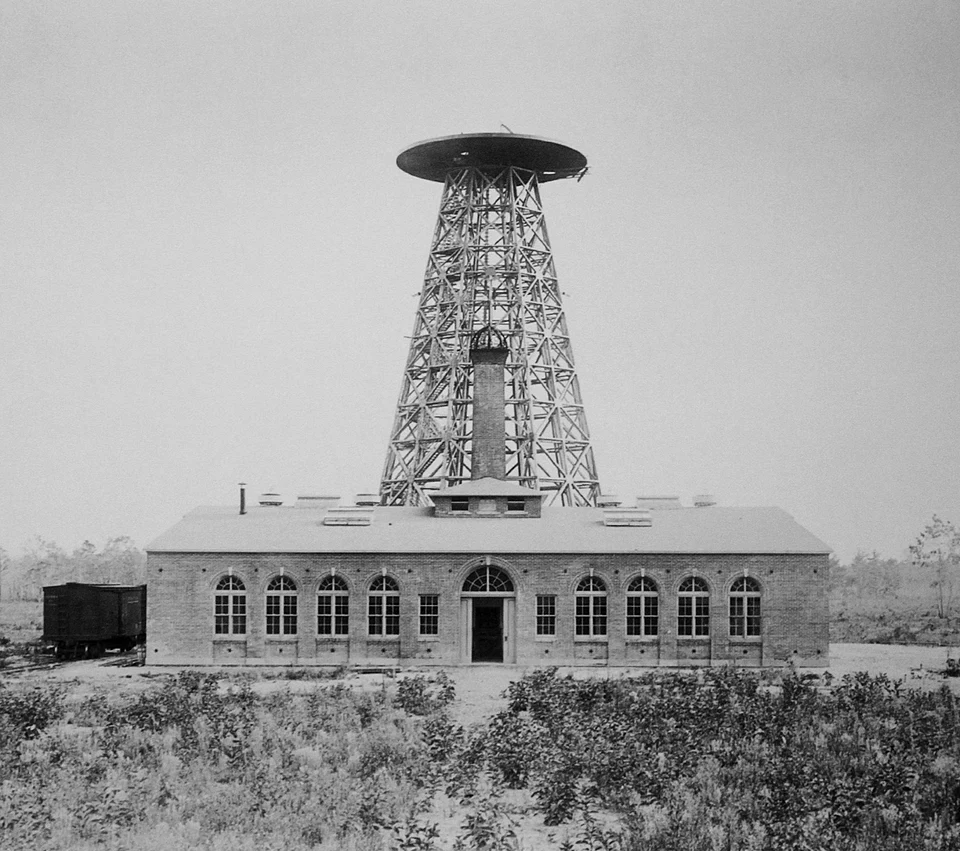
A 187 ft tower with a 68 ft cupola at Shoreham, Long Island, meant to send power as well as messages through the Earth and upper air. J.P. Morgan advanced more than $150,000 in 1901 for a communications system; Tesla expanded the plan toward global power, and Morgan declined to fund more.
Verdict: The communications foresight was genuine (see Wardenclyffe section). The power half was never demonstrated beyond short-range, low-efficiency laboratory lamp-lighting — and the famous “200 lamps lit from 25 miles” Colorado story appears in no dated entry of his own Notes.
Wireless power through the Earth
(c)
Colorado Springs Notes, 3 July 1899 · US 787,412 (1905)
Watching a receding thunderstorm, Tesla's instruments kept registering at regular intervals; he concluded there were stationary waves travelling through the Earth and reflecting from the antipode — and that the globe could be used as a conductor to deliver power anywhere. His patent calls Earth “a perfectly smooth or polished conductor of inappreciable resistance.”
Assessment: Real Earth is heterogeneous and lossy, with low Q for such modes; no modern experiment has reproduced power transfer by this method at useful efficiency. See the Atmosphere Problem section for the numbers.
Earth resonance vs. Schumann resonance
(c)
Tesla's round-trip figure ≈ 11.78 Hz · Schumann fundamental ≈ 7.83 Hz (predicted 1952)
These are different phenomena. Tesla's waves were supposed to travel through the body of the Earth; Schumann resonances travel around it, in the Earth–ionosphere cavity (surface to ~60–100 km), excited by global lightning. The frequencies sit in the same ELF ballpark because both scale with Earth's circumference divided by light speed — a dimensional coincidence, not an identity.
Verdict: Tesla may have qualitatively detected planetary ELF signals among other effects — a precursor observation (c). “Tesla discovered the Schumann resonance in 1899” overstates it (d), and claims that Earth's resonance is “rising and speeding up time” have no basis in Tesla or in monitoring data (d).
Teleforce — the “death ray” that wasn't a ray
(c)
Announced 11 July 1934 · treatise 1937, Nikola Tesla Museum, Belgrade
Tesla objected to “death ray”: rays “cannot be produced in requisite quantities and diminish rapidly in intensity with distance.” Teleforce instead proposed a concentrated stream of microscopic particles electrostatically accelerated in vacuum and fired through an open-ended tube — claimed to down 10,000 aircraft at 200 miles. Figures shifted across his own proposals (200 vs 250 miles; $2m per station). The USSR paid $25,000 (dated 1935 in teleforce literature, 1939 in one Smithsonian page — a flagged conflict). No prototype was ever built.
Physics: charged beams in air scatter, diverge and lose energy fast; one analysis puts his parameters' range at ~1.3 km against a claimed 400 km — a factor of about 300. The concept of particle-beam defence was anticipated; the device as specified is unworkable, and no government built one (d if claimed).
Dynamic theory of gravity & the ether
(c)
Announced 1937–38 · never published
Tesla said he had worked out a theory of gravity “in all details” in 1893–94, rejected Einstein's curved space (“the supposed curvature of space is entirely impossible”), and held that only a field of force in an ether could explain motion. No mathematical formulation, prediction, or manuscript has ever been found in the Belgrade archive.
Assessment: the former Tesla Museum director's summary stands: he announced it, never published details, “so any further story about that would be speculation.” The ether had been undermined by Michelson–Morley (1887); general relativity has since passed every test from Mercury's perihelion to gravitational waves (2015). An announcement without content is not a rival theory.
Thought photography
(c)
Interview, Kansas City Journal-Post, 10 Sep 1933
“I expect to photograph thoughts… a definite image formed in thought must, by reflex action, produce a corresponding image on the retina, which might possibly be read by suitable apparatus.” No apparatus was built and no patent filed.
Assessment: the premise is false — mental imagery is cortical; no optical image travels backwards onto the retina to be photographed. Modern fMRI/AI decoding of coarse visual imagery works from the cortex by a completely different mechanism, a century later. His related “checkerboard retina” idea did strikingly anticipate image transmission — television, realised by others.
Signals from Mars
(c)
Collier's Weekly, “Talking with the Planets,” 1901
In Colorado Springs in the summer of 1899 Tesla heard regular signals “which could not have been produced on earth,” concluded they were planetary, and by 1907–09 that they “must emanate from Mars.” He announced the idea in a December 1900 letter to the Red Cross.
Open: no recording survives, so the source can't be settled. Modern hypotheses: Marconi's July 1899 naval Morse “S” transmissions (three dots — matching Tesla's three pulses), natural Jupiter/Io plasma emissions (~10 kHz), or atmospheric interference. His belief was sincere; “Tesla communicated with Martians” as fact is (d).
Radar, described — not built
(c)
Electrical Experimenter interview, 1917
Tesla described detecting distant vessels by training short-wave impulses on them and picking up the reflection on a fluorescent screen — a clear conceptual description of radar.
Verdict: concept (c); he built no such system. Practical radar was developed independently in the 1930s in the UK, Germany, the US and elsewhere.
The earthquake oscillator story
(c) claim · (d) as fact
Oscillator patents US 511,916 / 514,169 (1894) · story told at his 1935 birthday press meeting
Tesla told this story himself, at 79 — 37 years after the alleged 1898 event: a small oscillator at his Houston Street lab shook the neighbourhood, brought police, and could supposedly destroy the Empire State Building with 5 lb of air pressure. The oscillator itself is real (a); it was designed for precisely regular oscillation.
Evidence: no contemporary 1898 newspaper, police or seismic record has been found. Resonance is real, but a 1–2 lb device holds far too little energy to shake down a steel building. MythBusters (2006) produced vibrations felt hundreds of feet away on a bridge — and no earthquake: “busted.”
“The Supreme Court gave Tesla radio in 1943”
(d)
Marconi Wireless Telegraph Co. v. United States, 320 U.S. 1 — decided 21 June 1943
The Court held Marconi's tuning patent claims invalid because anticipated — principally by John Stone Stone and Oliver Lodge; Tesla's 645,576 was discussed as also showing four tuned circuits, but Lodge supplied the variable tuning Tesla lacked. The Court expressly said Marconi's reputation for first successful radio transmission “rests on his original patent… which is not here in question.”
Reality: no Tesla patent was in suit, Tesla had died that January, and the case was Marconi Co.'s damages claim against the US government for WWI use. The Court declared no one “inventor of radio.” Full detail in the Radio section below.
The Philadelphia Experiment
(d)
Origin: Carl M. Allen's letters to Morris K. Jessup, 1955–56
The legend says USS Eldridge was made invisible and teleported in October 1943 using Tesla's secret work. The record says otherwise: Naval History and Heritage Command finds no such experiment; Eldridge was not in Philadelphia on the claimed date; the crew deny it; the logs contradict it — and Tesla died in January 1943, nine months earlier, with no document connecting him to any Navy invisibility project.
Kernel: degaussing — coils around a hull that reduce a ship's magnetic signature against mines. Real, routine, and not optical invisibility. Allen later admitted to investigators he had made parts up, then recanted — an unreliable sole source either way.
“3, 6 and 9 — the key to the universe”
(d)
No primary source · surfaces on quote sites in the early 2010s
The famous sentence appears in no Tesla patent, lecture, article, interview or My Inventions. It arrives fully formed, without citation, about a century after the fact.
Kernel: Tesla did document a compulsion that acts be divisible by three — counting steps, 18 napkins, hotel rooms divisible by 3 (Room 3327 included) — and described it himself as an affliction. “Vortex mathematics” and the “369 method” are later systems by other people, not Tesla's.
Free energy, Tunguska, flying discs, HAARP
(d)
No primary source for any of these
Free energy: Tesla wanted cheap, abundant power and Morgan did withdraw funding — but wireless power was never free to generate (Colorado's power was free to Tesla because El Paso Electric donated it), he never claimed energy from nothing, and no working system existed to suppress; his patents were published, not seized, in his lifetime. Tunguska (1908): Wardenclyffe was defunded and idle by then; the event matches a ~50–60 m airbursting asteroid/comet. Antigravity discs: sourced only to fringe self-published literature; his real aircraft patent is a propeller tilt-rotor. HAARP: see the HAARP box below.
Pattern: each legend starts from something real — a funding cut, a compulsion, a speculation — and extends it past every document. The documents are the check.
Nothing matches that search in this tier. Try clearing the search, or choose “All.”