A sourced field guide · Researched 20–21 November 2026

Nikola Tesla: what he built, what he only imagined, and what was never his

Tesla (10 July 1856 – 7 January 1943) was not the inventor of alternating current, the transformer, the light bulb, radio in its entirety, X-rays, neon signs, or free energy. He was, demonstrably, the inventor of the practical polyphase AC system and the AC induction motor — the system that still underlies the grid — plus the resonant transformer now called the Tesla coil, an early tuned wireless system, and the first radio-controlled vehicle. This page sorts everything else into its proper tier, then takes his boldest idea — power from the atmosphere itself — and checks it against the measured physics.

Every claim below carries the same four-way label used throughout, and each major claim names its source. Where sources conflict, the conflict is shown, not smoothed over.

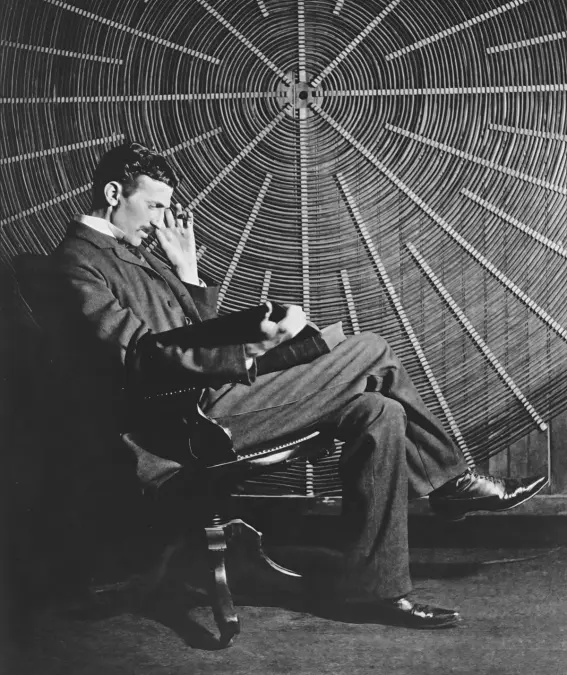
Black-and-white photograph of Nikola Tesla seated reading in his laboratory, with a large circular coil apparatus behind him
Tesla seated before a large coil in his New York laboratory, 1890s. Period photograph via image search; see Sources for the research this page is built from.
112
US patents, per the Nikola Tesla Museum, Belgrade
311+
Patent filings in 27 countries — many are foreign copies of the same invention
~125
Distinct inventions behind 116 basic patents — “~300 patents” is a filing count, not 300 inventions
1888
The year of the seven polyphase patents (1 May) and his landmark AIEE lecture (16 May)

How to read the patent count: the Museum counts 112 US patents and at least 311 patents in 27 countries; a US-only audit counts 111 utility patents plus a reissue. Both can be right — they count different things. Source: Nikola Tesla Museum figures via scienceshot.com; Svenson US patent audit — see Sources.

(a) Verified

Invention demonstrated in Tesla's lifetime — built, shown, and documented at the time.

(b) Patented, unrealised

A real patent that worked in prototype at most, and was never fully realised or commercialised at scale.

(c) Tesla's own theory

Speculation Tesla himself proposed in lectures, articles, or interviews — never reduced to a working, verified system.

(d) Myth

Later misattribution — never Tesla's claim or deed at all, however often it is repeated.

The life, in the order it happened

Born in Smiljan (then Austrian Empire, now Croatia) to a Serbian Orthodox priest, Milutin, and Đuka, whom Tesla credited for his inventiveness. He studied electrical engineering at Graz from age 19 and left in his third year, 1878.

  1. 1881–82 · Budapest

    The rotating field, in a park

    Working on telephone exchanges, Tesla later wrote that the idea for the rotating magnetic field “came like a lightning flash” while walking with Antal Szigety, reciting Goethe's Faust — a diagram sketched in the dirt. Treat the drama as autobiography written 37 years later in My Inventions (1919); the principle itself is corroborated by his 1887–88 patents.

  2. 1882–84 · Paris

    Continental Edison

    Employed by the Compagnie Continentale Edison; rose there, then emigrated to work for Edison directly.

  3. June 1884 · New York

    Arrival in America

    Sailed to New York “arriving with four cents in his pocket” and a letter from Charles Batchelor — “I know two great men and you are one of them. The other is this young man!” Smithsonian flags the letter's wording as purported.

  4. 1884–85 · Edison Machine Works

    The break with Edison

    Tesla later claimed Edison promised $50,000 for improving DC generators and then called it an “American joke.” That is Tesla's version only — no Edison-side document confirms a $50,000 offer, and Smithsonian presents it explicitly as “according to Tesla.” He quit, and briefly dug ditches.

  5. 1 & 16 May 1888

    The polyphase patents and lecture

    Seven patents granted on one day, including US 381,968 and 382,279–382,282; then the AIEE lecture “A New System of Alternate Current Motors and Transformers” at Columbia. In July, George Westinghouse licensed the patents — Smithsonian gives $60,000 in stock, cash and royalties; other histories give larger package figures depending on what is counted (see Open questions).

  6. 1891–93 · Lectures & Chicago

    High-frequency fame

    Lectures at Columbia (1891), the Royal Institution in London and Paris (1892), and the Franklin Institute and St. Louis (1893): wireless lamps, the Tesla coil, tuned wireless telegraphy. At the 1893 Chicago World's Columbian Exposition, Westinghouse lit the fair with AC and Tesla exhibited phosphorescent and electrodeless lamps.

  7. 1895–96 · Niagara

    Power from the Falls

    A fire on 13 March 1895 destroyed his Fifth Avenue lab, including early X-ray work. At Niagara, Westinghouse's October 1893 contract produced ten polyphase generators; first power flowed locally in August 1895, and transmission reached Buffalo — over 20 miles — in November 1896.

  8. 1899–1900 · Colorado Springs

    The magnifying transmitter

    At the Knob Hill lab (May 1899 – 7 January 1900), on power donated by the El Paso Electric Co., Tesla ran his largest coils and recorded 196 dated entries over 221 days in the Colorado Springs Notes — including the 3 July 1899 “stationary waves” observation that convinced him global wireless power could work.

  9. 1901–17 · Wardenclyffe

    The tower that never switched on

    The World Wireless System at Shoreham, Long Island: construction from 1901, work 1902–06, the property lost in 1915, the tower demolished for scrap in 1917. It never became operational. Full story below.

  10. 1905–28 · Later patents

    Turbine, valve, aircraft

    Bladeless turbine and pump (1913), speed indicators assigned to Waltham (1916–22), the Tesla valve (1920), and his last patents — the VTOL tilt-rotor aircraft (1928). Increasingly he lived on a small income and gave annual birthday press interviews.

  11. 1931–43 · Hotel New Yorker

    Room 3327

    Time put him on its cover for his 75th birthday in 1931. Westinghouse paid his hotel rent in his final years. He died on the evening of 7 January 1943, aged 86 — found on 8 January — of coronary thrombosis in the official account, and in debt.

Every major invention and theory, classified

Filter by tier, or search by name or patent number. Each entry states what it actually did, whether it was demonstrated, and where the honest verdict lands.

Polyphase AC system

(a)

US 381,968 · 382,280 · 381,969 · 382,279 · 382,281 · 382,282 · 390,721 — granted 1 May 1888

Tesla did not invent AC — that work began with Faraday in the 1830s, and transformers and single-phase systems predated him. His contribution was a complete, practical polyphase system: generator, transformers, transmission, and a commutatorless induction motor, patented as one coordinated set filed October–December 1887.

Impact: Licensed by Westinghouse in 1888; the foundation of modern grid practice. AC won distribution because transformers can step voltage up for low-loss long-distance transmission — a physics and economics result, not a duel outcome.

AC induction motor

(a)

US 381,968 — filed 12 Oct 1887, granted 1 May 1888

Two windings set 90° apart, fed by currents 90° out of phase, produce a magnetic field that rotates; a conductive rotor is dragged around by induction — no brushes, no commutator, rugged and self-starting. Tesla built working models in Strasbourg (1883, by his account) and New York (1887–88).

Priority note: Galileo Ferraris described the principle scientifically in 1885 but did not patent or commercialise a system, and himself acknowledged Tesla's independent work. Induction motors are today the dominant industrial motor type.

Tesla coil

(a)

US 454,622 (1891) · US 462,418 (1891) · US 568,176 (1896) · bifilar coil US 512,340 (1894)

A resonant air-core transformer: a spark-gap primary loosely coupled to a secondary, producing very high voltage at high frequency (tens of kHz to MHz) at low current. Demonstrated in the 1891–93 lectures — lamps lit through his body, wireless lamps, spectacular discharges.

Verdict: Real and still used for demonstrations, high-voltage testing and plasma niches. It is a transmitter/converter powered from a supply — not a power-distribution device, and not an energy source. Losses and radiation make it inefficient for distribution.

Tuned wireless signalling system

(a)

US 645,576 — filed 2 Sep 1897, granted 20 Mar 1900 · US 649,621 — granted 15 May 1900

Transmitter and receiver each tuned to the same resonant frequency, with ground and elevated terminals — the four tuned circuits described in his 1893 lectures and patented 1897–1900, before Marconi's US tuning patent filing. Signals are low-energy information, and at that, the system worked.

Keep separate: wireless signals (this entry) are not wireless power (a (c) entry below). Conflating the two is the single most common Tesla error.

Telautomaton — first radio-controlled vehicle

(a)

US 613,809 — filed 1 July 1898, granted 8 Nov 1898 · logic patents US 723,188 / 725,605 (1903)

A radio-controlled boat demonstrated at Madison Square Garden in 1898, answering coded signals and blinking lights in response to audience questions — called by a 2021 scholarly study “one of the first machines to receive instructions through wireless signals.” Tesla tried to sell it as a radio-controlled torpedo; the military showed little interest.

Legacy: Foundational for drones and remotely operated vehicles. His wider “telautomatics” — machines with a “borrowed mind,” sensors and sequential logic — anticipated robotics in words (c); the boat itself is solidly (a). He built no humanoid robot or computer.

Electrodeless lamps & carbon button lamp

(a) demo

US 455,069 (1891) · US 514,170 (1894)

In 1891–93 Tesla demonstrated gas-discharge and phosphorescent lamps lit wirelessly by a high-frequency field — including bent tubes forming words at his 1893 Chicago exhibit — and the carbon button lamp, a brilliant single-terminal point source.

Boundary: Demonstrations, yes; “Tesla invented fluorescent light and neon signs,” no. The commercial fluorescent lamp was GE's (1938), and the commercial neon sign was Georges Claude's (Paris, 1910) — neon gas itself wasn't isolated until 1898. A practical consumer lamp was never developed from Tesla's versions.

X-ray shadowgraphs

(a) experimental

Published in Electrical Review, 1896 — after Röntgen's announcement

Tesla experimented from about 1894 with Crookes tubes and noticed “a very special radiation” fogging photographic plates; much of that early material burned in the 1895 fire. After Röntgen's announcement he published shadowgraphs of a foot in a shoe and a hand, made with his own single-electrode tubes, corresponded with Röntgen (who congratulated him), and warned early about physiological hazards when many assumed X-rays harmless.

Verdict: A genuine pioneer experimenter in radiography's first months. He never claimed priority over Röntgen — “Tesla invented X-rays” is (d).

Speed indicators (Waltham)

(a) commercial

US 1,209,359 (1916) · 1,274,816 (1918) · ship's log 1,314,718 (1919) · flow meter 1,365,547 (1921) · frequency meter 1,402,025 (1922)

Air-friction and eddy-current drag indicators assigned to the Waltham Watch Co., advertised as Tesla inventions and fitted to Packard, Rolls-Royce and other cars of the period. One of his few royalty-earning later inventions.

Caveat: an air-drag speedometer was patented earlier by S. A. Asquith, so priority for the broad principle is contested; Tesla's specific form was the Waltham product.

Tesla valve

(a) niche today

US 1,329,559 — filed 21 Feb 1916, granted 3 Feb 1920

A fixed-geometry channel that flows much more easily one way than the other, with no moving parts — designed as a gas valve and turbine component. Genuinely rediscovered: it is used in microfluidics research today and modelled extensively in 2020s fluid-mechanics papers.

Honest limit: its one-way advantage (diodicity ~2–4 in the original form) is modest — a leaky check valve, not a perfect one.

Bladeless turbine & pump

(b)

US 1,061,142 (pump) · US 1,061,206 (turbine) — granted 6 May 1913

Smooth, closely spaced discs on a shaft; fluid spirals between them and drags them by viscosity and boundary-layer adhesion, exhausting at the centre. Reversed, it's a pump. Tesla called it his favourite invention and tested steam versions at New York's Waterside Station (~200 hp claimed in contemporary reports; efficiency claims were disputed and not independently sustained).

Why it failed: disc distortion and material failure at speed and temperature with 1910s steels, erosion, and poor efficiency at practical loads. It works — in modern niches for viscous, abrasive or delicate fluids — but never displaced bladed turbines.

Ozone generator

(b)

US 568,177 — granted 22 Sep 1896

A corona-discharge ozoniser of a type still used in principle for water and air treatment. Tesla marketed ozone apparatus through a small company.

Verdict: Real apparatus, small scale — with no evidence his was uniquely superior to the Siemens-type ozonisers that predated it.

Radiant-energy collector

(b)

US 685,957 / 685,958 — filed 21 Mar 1901, granted 5 Nov 1901

An insulated plate exposed to “radiant energy” — in context, sunlight and cosmic/UV/X-type radiation — charges a capacitor until it discharges through a small motor or device. An early description, in principle, of a radiation/solar-electric collector.

Verdict: The power is minute, Tesla claimed no over-unity, and nothing in the patent promises energy from nothing. Later “free energy from the vacuum” citations of this patent are (d).

VTOL “helicopter-plane”

(b)

US 1,655,113 / 1,655,114 — granted 3 Jan 1928, his last patents

Take off with the propeller axis vertical, then tilt the whole aircraft about 90° for forward flight on wings, with seats on trunnions staying upright — powered, in Tesla's proposal, by his lightweight turbine. Identified by aviation historians as possibly the first patented tilt-rotor/tilt-wing concept, an ancestor in configuration to the V-22 Osprey.

Verdict: Never built. The drawn propeller is far too small to lift the machine in hover by modern rotor theory, and no stability or transition-control solution is provided.

Wardenclyffe World Wireless — power

(b)/(c)

US 787,412 — filed 16 May 1900, granted 18 Apr 1905 · tower built 1901–06, never operational

A 187 ft tower with a 68 ft cupola at Shoreham, Long Island, meant to send power as well as messages through the Earth and upper air. J.P. Morgan advanced more than $150,000 in 1901 for a communications system; Tesla expanded the plan toward global power, and Morgan declined to fund more.

Verdict: The communications foresight was genuine (see Wardenclyffe section). The power half was never demonstrated beyond short-range, low-efficiency laboratory lamp-lighting — and the famous “200 lamps lit from 25 miles” Colorado story appears in no dated entry of his own Notes.

Wireless power through the Earth

(c)

Colorado Springs Notes, 3 July 1899 · US 787,412 (1905)

Watching a receding thunderstorm, Tesla's instruments kept registering at regular intervals; he concluded there were stationary waves travelling through the Earth and reflecting from the antipode — and that the globe could be used as a conductor to deliver power anywhere. His patent calls Earth “a perfectly smooth or polished conductor of inappreciable resistance.”

Assessment: Real Earth is heterogeneous and lossy, with low Q for such modes; no modern experiment has reproduced power transfer by this method at useful efficiency. See the Atmosphere Problem section for the numbers.

Earth resonance vs. Schumann resonance

(c)

Tesla's round-trip figure ≈ 11.78 Hz · Schumann fundamental ≈ 7.83 Hz (predicted 1952)

These are different phenomena. Tesla's waves were supposed to travel through the body of the Earth; Schumann resonances travel around it, in the Earth–ionosphere cavity (surface to ~60–100 km), excited by global lightning. The frequencies sit in the same ELF ballpark because both scale with Earth's circumference divided by light speed — a dimensional coincidence, not an identity.

Verdict: Tesla may have qualitatively detected planetary ELF signals among other effects — a precursor observation (c). “Tesla discovered the Schumann resonance in 1899” overstates it (d), and claims that Earth's resonance is “rising and speeding up time” have no basis in Tesla or in monitoring data (d).

Teleforce — the “death ray” that wasn't a ray

(c)

Announced 11 July 1934 · treatise 1937, Nikola Tesla Museum, Belgrade

Tesla objected to “death ray”: rays “cannot be produced in requisite quantities and diminish rapidly in intensity with distance.” Teleforce instead proposed a concentrated stream of microscopic particles electrostatically accelerated in vacuum and fired through an open-ended tube — claimed to down 10,000 aircraft at 200 miles. Figures shifted across his own proposals (200 vs 250 miles; $2m per station). The USSR paid $25,000 (dated 1935 in teleforce literature, 1939 in one Smithsonian page — a flagged conflict). No prototype was ever built.

Physics: charged beams in air scatter, diverge and lose energy fast; one analysis puts his parameters' range at ~1.3 km against a claimed 400 km — a factor of about 300. The concept of particle-beam defence was anticipated; the device as specified is unworkable, and no government built one (d if claimed).

Dynamic theory of gravity & the ether

(c)

Announced 1937–38 · never published

Tesla said he had worked out a theory of gravity “in all details” in 1893–94, rejected Einstein's curved space (“the supposed curvature of space is entirely impossible”), and held that only a field of force in an ether could explain motion. No mathematical formulation, prediction, or manuscript has ever been found in the Belgrade archive.

Assessment: the former Tesla Museum director's summary stands: he announced it, never published details, “so any further story about that would be speculation.” The ether had been undermined by Michelson–Morley (1887); general relativity has since passed every test from Mercury's perihelion to gravitational waves (2015). An announcement without content is not a rival theory.

Thought photography

(c)

Interview, Kansas City Journal-Post, 10 Sep 1933

“I expect to photograph thoughts… a definite image formed in thought must, by reflex action, produce a corresponding image on the retina, which might possibly be read by suitable apparatus.” No apparatus was built and no patent filed.

Assessment: the premise is false — mental imagery is cortical; no optical image travels backwards onto the retina to be photographed. Modern fMRI/AI decoding of coarse visual imagery works from the cortex by a completely different mechanism, a century later. His related “checkerboard retina” idea did strikingly anticipate image transmission — television, realised by others.

Signals from Mars

(c)

Collier's Weekly, “Talking with the Planets,” 1901

In Colorado Springs in the summer of 1899 Tesla heard regular signals “which could not have been produced on earth,” concluded they were planetary, and by 1907–09 that they “must emanate from Mars.” He announced the idea in a December 1900 letter to the Red Cross.

Open: no recording survives, so the source can't be settled. Modern hypotheses: Marconi's July 1899 naval Morse “S” transmissions (three dots — matching Tesla's three pulses), natural Jupiter/Io plasma emissions (~10 kHz), or atmospheric interference. His belief was sincere; “Tesla communicated with Martians” as fact is (d).

Radar, described — not built

(c)

Electrical Experimenter interview, 1917

Tesla described detecting distant vessels by training short-wave impulses on them and picking up the reflection on a fluorescent screen — a clear conceptual description of radar.

Verdict: concept (c); he built no such system. Practical radar was developed independently in the 1930s in the UK, Germany, the US and elsewhere.

The earthquake oscillator story

(c) claim · (d) as fact

Oscillator patents US 511,916 / 514,169 (1894) · story told at his 1935 birthday press meeting

Tesla told this story himself, at 79 — 37 years after the alleged 1898 event: a small oscillator at his Houston Street lab shook the neighbourhood, brought police, and could supposedly destroy the Empire State Building with 5 lb of air pressure. The oscillator itself is real (a); it was designed for precisely regular oscillation.

Evidence: no contemporary 1898 newspaper, police or seismic record has been found. Resonance is real, but a 1–2 lb device holds far too little energy to shake down a steel building. MythBusters (2006) produced vibrations felt hundreds of feet away on a bridge — and no earthquake: “busted.”

“The Supreme Court gave Tesla radio in 1943”

(d)

Marconi Wireless Telegraph Co. v. United States, 320 U.S. 1 — decided 21 June 1943

The Court held Marconi's tuning patent claims invalid because anticipated — principally by John Stone Stone and Oliver Lodge; Tesla's 645,576 was discussed as also showing four tuned circuits, but Lodge supplied the variable tuning Tesla lacked. The Court expressly said Marconi's reputation for first successful radio transmission “rests on his original patent… which is not here in question.”

Reality: no Tesla patent was in suit, Tesla had died that January, and the case was Marconi Co.'s damages claim against the US government for WWI use. The Court declared no one “inventor of radio.” Full detail in the Radio section below.

The Philadelphia Experiment

(d)

Origin: Carl M. Allen's letters to Morris K. Jessup, 1955–56

The legend says USS Eldridge was made invisible and teleported in October 1943 using Tesla's secret work. The record says otherwise: Naval History and Heritage Command finds no such experiment; Eldridge was not in Philadelphia on the claimed date; the crew deny it; the logs contradict it — and Tesla died in January 1943, nine months earlier, with no document connecting him to any Navy invisibility project.

Kernel: degaussing — coils around a hull that reduce a ship's magnetic signature against mines. Real, routine, and not optical invisibility. Allen later admitted to investigators he had made parts up, then recanted — an unreliable sole source either way.

“3, 6 and 9 — the key to the universe”

(d)

No primary source · surfaces on quote sites in the early 2010s

The famous sentence appears in no Tesla patent, lecture, article, interview or My Inventions. It arrives fully formed, without citation, about a century after the fact.

Kernel: Tesla did document a compulsion that acts be divisible by three — counting steps, 18 napkins, hotel rooms divisible by 3 (Room 3327 included) — and described it himself as an affliction. “Vortex mathematics” and the “369 method” are later systems by other people, not Tesla's.

Free energy, Tunguska, flying discs, HAARP

(d)

No primary source for any of these

Free energy: Tesla wanted cheap, abundant power and Morgan did withdraw funding — but wireless power was never free to generate (Colorado's power was free to Tesla because El Paso Electric donated it), he never claimed energy from nothing, and no working system existed to suppress; his patents were published, not seized, in his lifetime. Tunguska (1908): Wardenclyffe was defunded and idle by then; the event matches a ~50–60 m airbursting asteroid/comet. Antigravity discs: sourced only to fringe self-published literature; his real aircraft patent is a propeller tilt-rotor. HAARP: see the HAARP box below.

Pattern: each legend starts from something real — a funding cut, a compulsion, a speculation — and extends it past every document. The documents are the check.

Nothing matches that search in this tier. Try clearing the search, or choose “All.”
The radio question — and what the Supreme Court actually said

Radio was a multi-inventor system: Hertz (waves, 1887), Branly and Lodge (coherer), Popov, Fessenden, de Forest, Armstrong, Stone, Tesla, Marconi and others each contributed pieces. Anyone crowned its sole inventor — Tesla or Marconi — is a (d).

What each man genuinely did

Tesla's priority: the tuned four-circuit system, described in lectures in 1893 and patented 1897–1900 (US 645,576 / 649,621), predating Marconi's US tuning filing.

Marconi's achievement: the first practical, commercial, long-distance wireless telegraphy — the December 1901 transatlantic signal and the network that followed; Nobel Prize 1909, shared with Braun. Tesla never built a competing commercial messaging network.

1904: the US Patent Office reversed its earlier position and granted Marconi US 763,772 for four-circuit tuning. Tesla protested.

320 U.S. 1, decided 21 June 1943

“The broad claims of the Marconi Patent No. 763,772 … held invalid because anticipated.”— Syllabus, Marconi Wireless Telegraph Co. of America v. United States

The prior art the syllabus names is principally John Stone Stone (714,756) and Oliver Lodge (609,154). Tesla's patent was discussed, but Lodge provided the variable tuning Tesla's lacked. And the Court added that Marconi's reputation for first successful radio transmission rests on an earlier patent “not here in question.”

The conflict, flagged: the Tesla Science Center and Smithsonian both simplify this into “the Court ruled for Tesla.” The opinion text contradicts the simplification — so this page reports the opinion.

Wardenclyffe: the vision that was half right

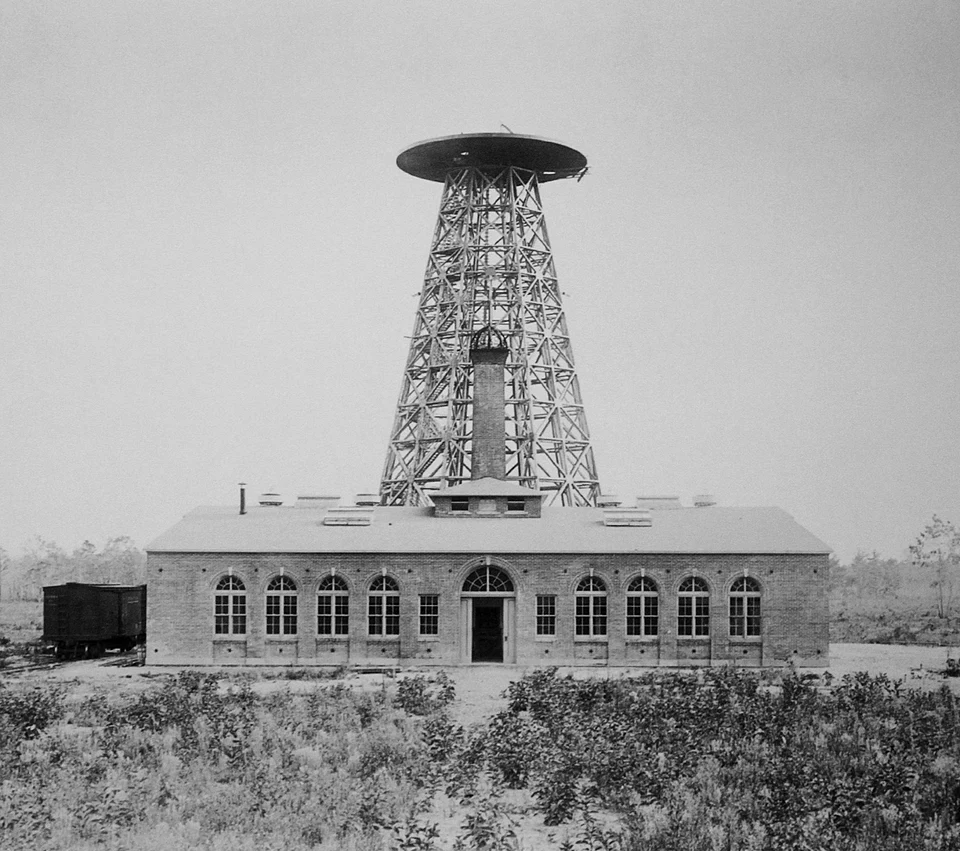
Shoreham, Long Island. Architect Stanford White. A 187 ft tower with a 68 ft cupola over an extensive underground ground system. (Published shaft and root-system depths vary — 120 ft in PBS accounts, far more in popular ones; the Belgrade engineering drawings would be needed for a definitive figure, so no single depth is quoted here.)

Historic photograph of the Wardenclyffe Tower — a tall lattice tower with a domed cupola — behind the brick laboratory building at Shoreham, Long Island
Wardenclyffe Tower and laboratory, Shoreham, Long Island (Wikimedia Commons image located via image search). The tower was demolished for scrap in 1917; the laboratory building survives as the Tesla Science Center at Wardenclyffe, on the National Register.

The money, honestly

J.P. Morgan advanced more than $150,000 (roughly $5m+ today) in 1901 — for a wireless communication system to compete with Marconi and the cables. Tesla expanded the plan, largely without clear disclosure to Morgan, toward global power, which needed a far larger plant (he later sought ~$1m total). Morgan declined further funding.

The famous line — Morgan asking “Where do I put the meter?” — is apocryphal as a verbatim quote: no primary document carries it. It summarises a real commercial problem: power broadcast to everyone cannot easily be billed to someone.

Marconi's cheaper, successful December 1901 transatlantic signal undercut Wardenclyffe's communications business case. The project effectively ended by 1906; foreclosure followed, the property was lost in 1915, and the tower was dynamited and sold for scrap in 1917 to pay debts.

The foresight that was real

In the same vision, Tesla anticipated mobile telephony and internet-like services with startling accuracy — quoted by Smithsonian: a businessman dictating in New York and seeing it appear in type in London; calling “any telephone subscriber on the globe” from his desk; an instrument “not bigger than a watch” letting its bearer hear speech and music anywhere; pictures transferred from place to place; “millions of such instruments… operated from but one plant.”

That communications foresight is genuine — later realised by others, by different means (Hertzian radio plus networks). The power half of the same vision remains unrealised, for the physics set out next.

The Atmosphere Problem: can Tesla's ideas pull usable power from the air?

This is the question underneath the whole legend — the hope of power drawn from the atmosphere and ionosphere, independently, without harming the environment. It deserves a precise answer, not a dismissal and not a promise. Here it is, with the working shown, so anyone can check the arithmetic. Short answer: the atmosphere really is electrified, Tesla really did propose tapping it — and the measured energy there is roughly a million to a billion times too dilute for watt-level power. The honest niche is microwatt-to-milliwatt trickle power for sensors.

First, what Tesla actually claimed — four ideas legend merges into one

1 · The atmosphere as a wire

His main idea (1893–1905): use the Earth as one conductor and a charged conductive upper layer as the return path — a concept traceable to Mahlon Loomis's 1872 proposal, so not originated by Tesla. In Collier's (1901) he described his machine as a pump “drawing electricity from the Earth and driving it back into the same at an enormous rate.” Read the direction of flow: the pump is powered at the transmitting station. He claimed to send energy this way — never, in that article, that the energy was free or net-positive at the receiver.

2 · The atmosphere as a feedstock

His 1900 Century article is titled “…with Special Reference to the Harnessing of the Sun's Energy.” Its atmospheric proposal is nitrogen fixation: a 12-million-volt discharge “burning the nitrogen of the atmosphere” into fertiliser compounds. That spends a large input of electricity to make chemicals from air — the atmosphere is the raw material, not the fuel. Citing this article as a free-energy claim inverts it.

3 · “Radiant energy” — a real, minute collector

The 1901 plate-and-capacitor patents (US 685,957/8) convert an incoming radiation flux at that flux's power density — for cosmic rays at sea level, about 0.1 µW per square metre before capture losses. Tesla claimed no over-unity and no large power for it. The “unlimited radiant energy” literature layered onto it later (and T. Henry Moray's separate, never-verified 1930s device) is legend, not Tesla.

4 · The cosmic-ray motor — announcements without a device

On his 75th birthday (1931, Brooklyn Eagle): “I have harnessed the cosmic rays and caused them to operate a motive device.” In 1933 (New York American): cosmic energy “everywhere present in unlimited quantities.” But no device was ever shown, no patent filed, no drawing, no witness, no wattage. His accompanying physics was wrong (particles “exceeding the velocity of light”), and even his own comparison — “thousands of times more powerful” than a Crookes radiometer, a milliwatt-scale toy — describes at most a small motor. The 1931 Pierce-Arrow “cosmic energy car” story is not even Tesla's claim: it rests on a “nephew Peter Savo” who did not exist, and his grand-nephew William Terbo dismissed it as a fabrication — (d).

Colorado Springs and Wardenclyffe were transmitters powered by conventional generators — Colorado ran on coal-generated grid power donated by El Paso Electric. Energy flowed out of the power station into Earth and air, never the reverse. No primary source shows Tesla extracting usable net power from the atmosphere.

The measured physics — three numbers decide it

2 pA/m²
Fair-weather air–Earth current density
The current actually flowing through each square metre of Earth's surface (J ≈ 2×10⁻¹² A/m²), set by air's conductivity σ ≈ 2×10⁻¹⁴ S/m times the field E ≈ 100 V/m. Source: Finnish Meteorological Institute.
250–300 kV
Ionosphere-to-ground potential
The full voltage the planet offers, between the ionosphere (~60–100 km up) and the ground. A tower terminal does not reach it — the air in between is the insulator that lets this voltage stand at all.
0.5 µW/m²
Total power available per square metre
P/A = J × V = 2×10⁻¹² × 2.5×10⁵ ≈ 5×10⁻⁷ W/m². Cross-check: × Earth's 5.1×10¹⁴ m² ≈ 255 MW — matching the independently cited ~250 MW for the entire planet's circuit, maintained by ~1,500–2,000 thunderstorms leaking ~1 A each.

Try it: how much countryside does one load need?

At 100% efficiency and the full ionospheric voltage — both unattainable, so these are optimistic lower bounds — a collector must drain the fair-weather current of this much land to sustain your load:

Benchmarks from the research: 1 mW ≈ 2,000 m² · 1 W ≈ 2 km² · 5 W (phone charging) ≈ 10 km² · 100 W ≈ 200 km² · 1 kW ≈ 2,040 km² — “a region 51 km across drained through one collector” (Treat & Rosignoli assessment). The bottleneck is the air itself: its conductivity is some 28 orders of magnitude worse than copper's. No electrode, coating or resonant circuit changes the conductivity of the kilometres of air around it.

Power density, honestly compared (log scale)

Watts per square metre. Each bar's length is proportional to log₁₀ of the value, from 10⁻⁹ to 10³ W/m² — the only honest way to show a range this wide. Figures as sourced in the research notes.

10⁻⁹10⁻⁶10⁻³110³ Peak sunlight 1,000 Solar panel output 150–220 TENG (mechanical) 0.291 Atmospheric circuit 0.0000005 Cosmic rays (sea level) ~0.0000001 Schumann resonance ~10⁻⁹

Solar beats the atmospheric circuit by a factor of roughly 400 million per square metre — and even an overcast winter day (~15–70 W/m²) beats it by more than ten million times. The TENG figure is mechanical harvesting (wind, rain, motion) — legitimate, promising, and often mis-cited as if it tapped the electric field; it does not.

Where attempts actually land — measured outputs

ApproachWhat it really tapsMeasured outputVerdict
Balloon/tether collector (Jefimenko 1971; Stong 1974; Treat & Rosignoli 2011)Global electric circuit0.8 µA at 275 ft ≈ 6.7 mW grossReal physics, toy power — the best honest data point in the field, from a collector effectively draining a disc of ~360 m radius. Earlier corona motors merely spin, unloaded.
Plauson balloon plants (1925)Same circuit, claimedClaimed 1.8 A at 400 V; “200 hp” from 100 balloonsA patent grant is not a measurement. Never independently reproduced in a century — and 1 kW would need ~2,040 km² drained.
Ambient RF harvesting (rectennas)Man-made broadcasts — not the natural atmosphere47 µW at 70 m from a base station; up to 40 µW DC at −10 dBm inputWorks — for sensors that sleep at microwatts and transmit in bursts. Authors note it is “still insufficient to fully supply a wireless sensor in full active mode” (11–23.7 mW).
Dedicated wireless power (for contrast)A transmitter you powerQi charging 5–15 W at millimetresWatt-level wireless power exists only at very short range from a powered transmitter — Tesla's near-field intuition, not atmospheric harvesting.
“Air-gen” humidity harvesting (UMass, Nature 2020)Moisture gradient — the water cycle, ultimately solar~0.5 V sustained · ~17 µA/cm² · ~4 mW/cm³Peer-reviewed and genuinely novel — the most interesting modern “electricity from air” result, and not Tesla's mechanism. Milliwatt-class, no commercial product, scaling questions open.
Lightning harvestingThunderstorm discharge~1 MJ (≈¼ kWh, “about a nickel”) per typical strike at a ground terminalTotal flash energy figures (~1–5 GJ) count energy dissipated in the air itself. What reaches a terminal arrives in microseconds at millions of volts, a few times a year, unpredictably. Lightning authority Martin Uman: harvesting it from the ground is “hopeless.”
Why it fails — the fundamental flaws (not fixable by a cleverer circuit)

1. The current isn't there. A collector doesn't generate current; it diverts a fixed 2 pA/m² from a huge area. The limit lives in the air, not the circuit — a better waterwheel does not create water.

2. Impedance. The source is kilovolts at picoamps-to-microamps — gigaohm source impedance. Draw more and the local field collapses; the collector's own charge screens it and corona leaks it away. The impressive voltages in demonstrations are evidence of this problem: P = V × I, and I is ~10⁻⁶ A.

3. Resonance creates nothing. A Tesla coil trades current for voltage with losses; resonance recirculates reactive power (energy sloshing between coil and capacitor each cycle). Only the real part is delivered, and it is always ≤ input. No arrangement of Maxwell's equations lets a passive resonant system deliver more average power than it receives.

4. Transmission is a second, separate wall. Even conventionally generated power (Tesla's actual Wardenclyffe plan) sent through Earth and air faces spreading and resistive loss in a heterogeneous Earth, corona and radiation loss at the terminal, and no way to confine flow to intended receivers.

5. The generator is already loaded. Thunderstorms maintain the circuit in steady state; its ~250 MW is dissipation, not an unused reservoir waiting behind a dam.

The measurement traps behind modern “free energy” claims

Apparent vs real power: multiplying Vrms × Irms in a resonant circuit, where voltage and current sit ~90° out of phase, yields reactive volt-amperes, not watts. Correct method: time-average of instantaneous v(t)·i(t), on input and output alike.

Open-circuit volts, short-circuit amps: quoting each separately implies a product no load ever sees; a matched load gets at most ¼·Voc·Isc — typically milliwatts or less.

A lit lamp or spinning motor proves voltage, not wattage: neon tubes strike on microwatts; electrostatic motors spin at 500 rpm with essentially no torque. Ask for torque × speed, or V²/R across a load resistor, sustained.

Hidden inputs: mains leakage through instrument grounds, capacitive coupling from wiring or the experimenter's body, pre-charged storage — and, outdoors, grid induction and broadcast RF, which genuinely deliver microwatts and get credited to “the atmosphere.”

Peak vs average: pulsed devices quote instantaneous peaks (kW–MW/m² for microseconds); energy per pulse × pulses per second is the average — routinely 3–6 orders of magnitude lower.

What is genuinely still open

Better coupling: can corona-emitter arrays or electrets raise local current density above 2 pA/m² without spending more on ionisation than is recovered? No net-positive demonstration yet — a legitimate question with a clear success test.

Air-gen scaling: what maintains the moisture gradient, and what are the true area limits? Active, peer-reviewed, unresolved in scaling — not forbidden, because it taps the water cycle, a far larger flow.

Storm-time fields: fields reach 1,000–30,000+ V/m under thunderstorms — but for minutes a year at a site, with lethal lightning risk; the duty cycle caps average power at a tiny value regardless.

The cavity as a signal: ELF/Schumann monitoring for geophysics and lightning detection is real and growing — Tesla's signalling intuition, at microwatt levels, was directionally right.

None of these, resolved favourably, changes the fair-weather arithmetic above. They concern other reservoirs, or better conversion of the same tiny flux.

The verdict, stated precisely

For watt-level sustained power from atmospheric electricity: no physically plausible path exists — not because of any single invention's failure, but because of bookkeeping on measured quantities: 2 pA/m² at a maximum of 250 kV is 0.5 µW/m², and one sustained watt needs ~2 km² of countryside drained at impossible 100% efficiency. A system designed around atmospheric electricity as a power source would fail by 6–9 orders of magnitude.

What would change this assessment: one independently replicated result — a collector of stated size, in stated weather, delivering ≥1 W average over ≥24 hours into a real load, measured as time-averaged v·i at the load with every input accounted for. Its absence across a century of attempts, all reporting microwatts to milliwatts for this channel, is itself strong evidence the bound is real.

For genuine off-grid resilience, the physically sound “energy from the environment” is the one Tesla's own Century programme pointed to: the Sun — solar (150–220 W/m² of panel output) plus wind where the site suits it, plus storage. Atmospheric or RF trickle belongs, if anywhere, as a sensor-level tertiary source: at 10 µW, filling one AA cell (~9,000 J) takes about 28 years.

⚠ Safety — read before any experimental work in this area

This page contains no build instructions for any high-voltage device, deliberately. The hazards are not theoretical:

  • Tesla-coil primary circuits can kill. A commercial small-coil manual warns its primary side runs ~270 V DC at up to hundreds of amperes — “just 10 mA across your heart is enough to kill you” — and capacitors can hold a lethal charge for at least five minutes after switch-off. The belief that high-frequency output is safe “because of skin effect” is false: RF burns can be deep, and a shock can throw you onto the far more lethal primary.
  • Elevated atmospheric collectors are lightning attractors. A tether, balloon line or tall antenna raised to collect charge is functionally a lightning rod wired to your equipment. Treat lightning as a lethal, destructive event for such a system — never an energy bonus — and never raise collectors in or near storms.
  • Ozone and nitrogen oxides from corona and spark discharges are toxic if concentrated and damage lungs even below the smell threshold; ventilation is essential around any discharge.
  • Interference: coils emit broadband RF that can affect pacemakers and other implants — people with implants should not be near an operating coil — and can damage nearby electronics.

Atmospheric-electric experiments, if pursued at all for the sensor niche, belong at instrument scale — picoammeters, field mills, commercial RF-harvesting evaluation boards — not at high-voltage construction scale, where these hazards are incurred to harvest milliwatts.

HAARP, briefly and honestly

Kim asked for deep familiarity with HAARP — the ionospheric research facility in Alaska. The research behind this page covers it only briefly, and this box stays inside what that research actually documents rather than filling the gap from elsewhere:

What the research records: HAARP was a real ionospheric research facility in Alaska, operating 1993–2014 and university-operated thereafter. It belongs in this story for one reason — it is routinely claimed as a Tesla-derived weather or earthquake weapon. The research classifies that lineage as (d) myth: Tesla speculated about transmitting energy and mechanical effects at a distance (c) but built none of these systems, and HAARP's transmitter power is orders of magnitude too small for weather effects.

Open gap, stated plainly: a full HAARP research dossier — its experiments, publications and findings — was not part of the completed research this page is built from. Rather than invent one, this page flags it as an open item for a future research pass.

1943: the death, the seizure, and John G. Trump's report

After Wardenclyffe, Tesla never secured another laboratory of his own. He won the Edison Medal (1916, awarded 1917), lived in a succession of New York hotels often in arrears, fed pigeons in Bryant Park and Herald Square, and kept himself in public view with annual birthday press conferences and escalating claims.

Who actually seized the papers

Not the FBI. The seizing agency was the Office of Alien Property Custodian, acting under wartime Trading with the Enemy Act powers over property of nationals of enemy-occupied countries (Yugoslavia) — even though Tesla had been a US citizen since 1891, a propriety questioned inside government at the time. The FBI coordinated and was interested; it did not itself impound. The motive was wartime fear that teleforce and wireless papers could reach Axis or Soviet hands.

Nephew Sava Kosanović eventually claimed the estate; after legal proceedings the papers were shipped to Belgrade (1951–52; sources differ on the exact year convention), and the Nikola Tesla Museum opened on 5 December 1952. The FBI Vault released about 250 pages in 2016, with more in 2018 — mostly correspondence, crank letters, and post-death enquiries. Mundane, and public.

Trump's report — and its scope

John G. Trump, MIT high-voltage professor, examined the hotel and storage material over about three days in January 1943 and concluded that Tesla's thoughts and efforts “during at least the past 15 years were primarily of a speculative, philosophical and promotional character” and “did not include new sound, workable principles or methods for realizing such results.”

The caveat both sides miss: Trump examined only the seized material, for one national-security question, in days. He did not assess — or disparage — the 1888–1900 engineering. His report is neither a cover-up nor a verdict on Tesla's whole career.

The “80 trunks seized, only 60 arrived” claim counts different units (trunks vs packages, barrels, suitcases) at different stages; no declassified document shows a working weapon was retained. Some Tesla material legitimately remains in US archives by ordinary donation and purchase.

Open questions — what the research could not verify

Listed plainly, because an honest “we don't know” is worth more than a confident guess.

  • The exact Westinghouse licence total. $60,000 cash/stock plus royalties (Smithsonian) versus ~$1m package figures elsewhere — both circulate; the original contract terms sit in archives not fully reproduced in the sources consulted. No single total should be quoted without that caveat. The related story of Tesla tearing up the royalty contract is told in every biography, but the amount forgone is speculative, not auditable.
  • The Soviet teleforce payment date. $25,000 is consistently reported; the year is 1935 in teleforce literature and 1939 in the Smithsonian page consulted. Unresolved from a primary Amtorg record in this research.
  • What Tesla actually heard in 1899. No recording or calibrated data survives; the Marconi-“S”, Jupiter–Io, and atmospheric explanations are all retrospective hypotheses.
  • Three famous anecdotes rest on one side's telling: Edison's $50,000 promise, Morgan's “where do I put the meter?”, and the torn-up royalty contract all trace ultimately to Tesla, O'Neill, or Cheney — not to contemporaneous documents from the other party.
  • Wardenclyffe's underground works. Shaft and root-system figures conflict across reputable sources; Belgrade's engineering drawings would be needed for a definitive number.
  • HAARP's research record in full — flagged in the HAARP box above as not covered by this research pass.

Sources & how to read Tesla

Start with Tesla's own words, carefully: his patents (reliable for what he claimed and when, not for whether it sold), the 1888–93 lectures, “The Problem of Increasing Human Energy” (Century, June 1900 — the best single source for his worldview), the Colorado Springs Notes (contemporaneous, includes failures — the most reliable Colorado record), and My Inventions (1919 — indispensable and unreliable in equal measure). The scholarly standard biography is W. Bernard Carlson, Tesla: Inventor of the Electrical Age (Princeton, 2013); John J. O'Neill's Prodigal Genius (1944) is the source of many famous anecdotes and should be treated as hagiography, not verification. The Nikola Tesla Museum, Belgrade, holds ~160,000 documents (UNESCO Memory of the World, 2003) and is the authority for patent counts.

Tesla Science Center — Inventions & Wireless Power
teslasciencecenter.org/nikola-tesla-inventions
teslasciencecenter.org/teslas-wireless-power
Smithsonian Magazine — the Wardenclyffe tower
smithsonianmag.com/history/nikola-tesla-tower…
National Park Service — Wardenclyffe Laboratory
nps.gov/places/wardenclyffe-laboratory.htm
Patent inventories
scienceshot.com — What Did Nikola Tesla Invent?
svensons.com/tesla — complete US patent collection
patents.google.com/patent/US568176 · US1655114
Marconi v. United States, 320 U.S. 1 (1943)
chanrobles.com — opinion & syllabus
teslainfo.org — “The Supreme Court did not rule Tesla invented radio”
libguides.uml.edu — Wunsch, “Misreading the Supreme Court”
Tesla Record — wireless power analysis
teslainfo.org/what-tesla-actually-proposed-wireless-power
Tesla, “The Problem of Increasing Human Energy” (1900)
borderlandsciences.org — full text
archive.org — full text (atmosphere analysis)
Telautomaton scholarship (Wuebben, 2021)
zenodo.org — Public Understanding of Science paper
Edison Tech Center — Niagara & induction lamps
edisontechcenter.org/niagara
edisontechcenter.org/induction-lamps
Death & the 1943 seizure
inthehistory.com — Tesla's papers: the 1943 seizure
history.com — the declassified files (Trump report)
Atmospheric electricity — the numbers
space.fmi.fi — fair-weather atmospheric electricity
Treat & Rosignoli (2011) — experimental results & assessment
Springer — global electric circuit review
Modern harvesting, measured
nature.com — Liu et al., Air-gen (2020)
mdpi.com — multiband rectenna study
pdg.lbl.gov — cosmic rays review (2022)
journals.plos.org — Schumann amplitudes
Lightning & safety
engineering.mit.edu — harnessing lightning
unsw.edu.au — can we store lightning energy?
onetesla.com — user manual (hazard warnings)
donklipstein.com — Tesla coil hazards & safety
Myth checks
gemater.com — did Tesla say “3, 6, 9”?
navalhistoria.com — the Philadelphia Experiment
seecheck.org — gravity-theory fact-check (Jovanović)
en.wikipedia.org/wiki/Teleforce